
Social Media Will Become the Internet's Main Artery! 4 Reasons
by Eiji Kitamura
A few years have passed since Twitter first appeared on the scene. At first, I didn't quite get the point and used it simply because it was generating buzz, but today it has become completely integrated into my everyday life. While I sometimes wonder if I might be a little addicted, I'm sure quite a few people feel the exact same way. Its momentum shows no signs of slowing down, and its adoption rate in Japan continues to climb. Even among my friends who don't work in the tech industry, I'm starting to see people pop up on the platform.
It might sound like an exaggeration, but I believe that what we call "social media"—including Twitter—is set to become the main artery of the Internet moving forward. In this post, I'd like to share my thoughts on why.
Note: As many of you may have already noticed, the term "social media" as used today clearly differs from what it meant a few years ago when referring to one-way services like blogs or YouTube. Today's "social media" refers to bidirectional microblogging, epitomized by Twitter feeds and Facebook walls. Please keep in mind that this post is written with that definition in mind.
From Search to Social Media #
Before social media, the center of online life was without question search engines. It was often said that "if it doesn't appear in search results, it might as well not exist on the web," giving rise to practices like SEO and SEM along with entire industries built around them. Whenever someone launched a new service or media site, running ads and figuring out how to rank at the top of search results made the difference in whether everyday users would ever find it. Recently, however, statistics show that the landscape is beginning to shift.
- Facebook directs more online users than Google
- Top 8 reasons why your business will need Social Media Optimization
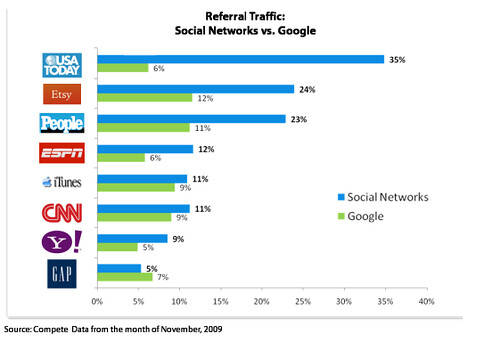
This graph compares the traffic sources of several sites between social networks and Google. When your own site's inbound traffic starts looking like this, it becomes clear that focusing exclusively on SEO is no longer viable.
Until now, portal sites and search engines have handled the job of sorting and organizing the infinite amount of information out there, but it is hardly an exaggeration to say that social media will increasingly capture that share moving forward.
Social Media for Developers #
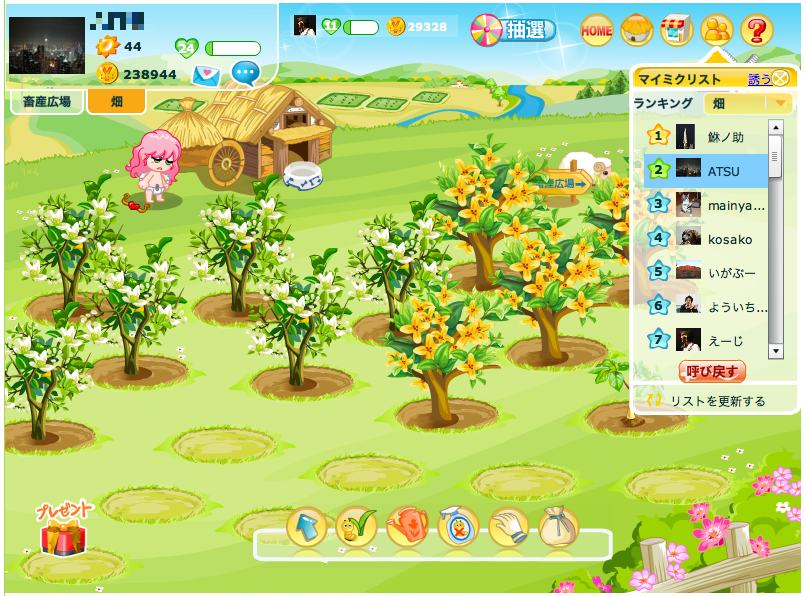
Ever since mixi apps launched last year, interest in social applications has been skyrocketing. It's safe to say we are in the middle of a gold rush.
There are several reasons why social applications are so popular, but the most important one is that third parties provide compelling apps. And what supports that is the inherent social nature of the host social network. Users who enjoy an engaging app share it with their friends, spreading the word, and fueled by that traction, developers deliver even better apps. It is precisely this virtuous cycle that sustains the popularity of social apps.
One key element powering this word-of-mouth spread is what is known as the activity stream. In mixi apps, it is displayed as "app updates."
In fact, this activity stream is itself a form of social media. I suspect that on mixi, these will eventually be merged directly into the mixi Voice stream. If that happens, it will reach users even more naturally and carry far greater influence.
Take Foursquare as an example. As I mentioned in a recent article, Foursquare boosted its value by integrating with Twitter and Facebook, inserting its updates directly into users' timelines. (Needless to say, even though Foursquare is not an app hosted directly inside an SNS, it can be considered a social application in the sense that it leverages the social graph and activity streams.)
In this way, being able to tap into the timelines that users check on a daily basis provides an inherent advertising effect for social apps. When you combine that with the viral word-of-mouth effect, it goes without saying just how crucial social media is for developers. Social media is undoubtedly one of the key factors behind the emergence of apps that attract a million users in just a single month.
Social Media for Marketers #
Many of you have likely heard the term Social Media Marketing. It refers, quite literally, to marketing through social media, and it seems to have become a hot topic among marketers lately.
While it is outside my core area of expertise, I would define social media marketing as "marketing conducted by businesses engaging directly with users inside social media channels."
Social media is drawing enormous attention as a channel for information distribution. Trends are shifting from search-driven marketing techniques like SEO and SEM toward social-media-based approaches, and terms like SMO (Social Media Optimization) and SMM (Social Media Marketing) are becoming increasingly common.
Many marketers have their eyes on the viral word-of-mouth spread inherent to social media, as described earlier. This excitement is likely here to stay for quite some time.
Recommended blogs:
Emerging Technologies #
By now, you likely understand just how much potential social media holds. However, some might think, "Doesn't that just mean Twitter and Facebook are impressive?" Why say "social media will become the main artery" instead of "Twitter and Facebook will become the main artery"? The answer is that new technologies are emerging, and a future where diverse social media platforms connect seamlessly is right around the corner.
Social Media May Get Much More Convenient for Businesses
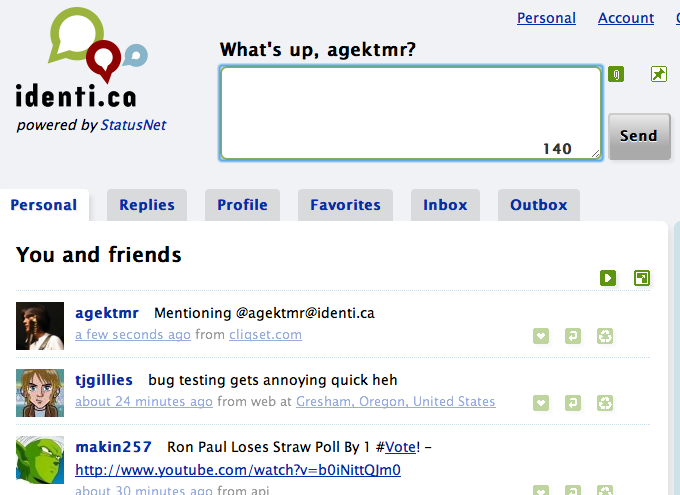
It might be a little hard to tell at first glance, but this screenshot shows a mention sent from Cliqset.com to my account on identi.ca. Notice how it appears in the timeline even though the identi.ca account does not follow the Cliqset.com account? (In fact, you can follow across them too!).
Cliqset.com is a FriendFeed-style social media aggregator. identi.ca is a demo site for status.net, an open-source project that serves as a decentralized microblogging platform similar to Twitter. Both made this possible by early adoption of cutting-edge social web technologies such as ActivityStreams, WebFinger, Salmon Protocol, and PubsubHubbub.
Once we can go this far, there is no longer any reason to remain locked into Twitter or Facebook alone. Users will be able to stick with whichever social media service they prefer—be it Twitter, Facebook, or something else—and freely follow and communicate with others without needing to worry about what service the other person is using.
In other words, the future growth of social media will not depend solely on the standalone popularity of Twitter or Facebook.
Conclusion #
With strong backing from SNS operators, developers, and marketers, alongside the growing ability to deliver utility unconstrained by any single platform, the momentum of the era is undeniably shifting toward social. When people sit down in front of a computer screen and open a browser, how do they find the information they are looking for? It seems clear that the path to discovery is shifting away from portal sites and search engines toward a social-media-centric model.
If you are a director of a web service, how will you attract users? If you are a marketer launching a new product, how will you promote it? While you certainly shouldn't stop thinking about search, you can no longer afford to underestimate marketing through social media. In fact, by actively leveraging it, it is becoming possible to drive user acquisition at a scale that was previously unimaginable.